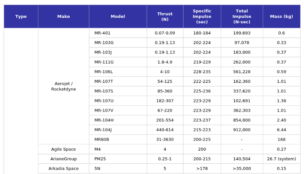
Commercial In-Space Propulsion Options
A catalogue of in-space propulsion options—vendors, products, and specs.
 2026 Payload Pro | All Rights Reserved.
A catalogue of in-space propulsion options—vendors, products, and specs.
Earlier this week, Kepler (an optical comms relay business) launched its first ten 300-kg sats and announced a deal with OroraTech, to host its thermal sensors and speed up downlink via its laser-linked routing.
Some of that spectrum still sits in legacy hands, ripe for acquisition.
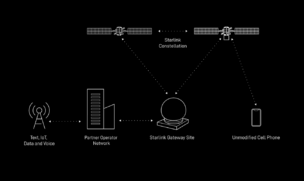
The deal resets SpaceX’s direct-to-cell (DTC) 5G ambitions, reshapes the DTC competitive landscape, impacts downstream competitor vendors, and could redefine the relationship between mobile carriers and satellite providers.
Satellite bus manufacturing used to be the domain of a handful of national aerospace primes. Over the past 20 years, however, two major startup waves have disrupted this status quo.
But there are enormous technical hurdles that need to be overcome. So, we spoke to Starcloud and Sophia Space, two startups building data centers in space, to understand the opportunity and separate the fact vs. fiction.
Fast forward five years, and that $10B number seemed to be more of a nice round number for Amazon to throw out into the ether, rather than a diligently thought-out budget.
After years of investor malaise and memes about the region’s lack of innovation, investing in the EU is suddenly back in vogue.
AST SpaceMobile announced a landmark agreement with Ligado Networks last month that will provide AST 40 MHz of L-band Mobile Satellite Service (MSS) spectrum across the US and Canada, as well as an additional 5 MHz of spectrum in the US.